I’m Starting to Think the Boring Technologies Might Make the Best Companies


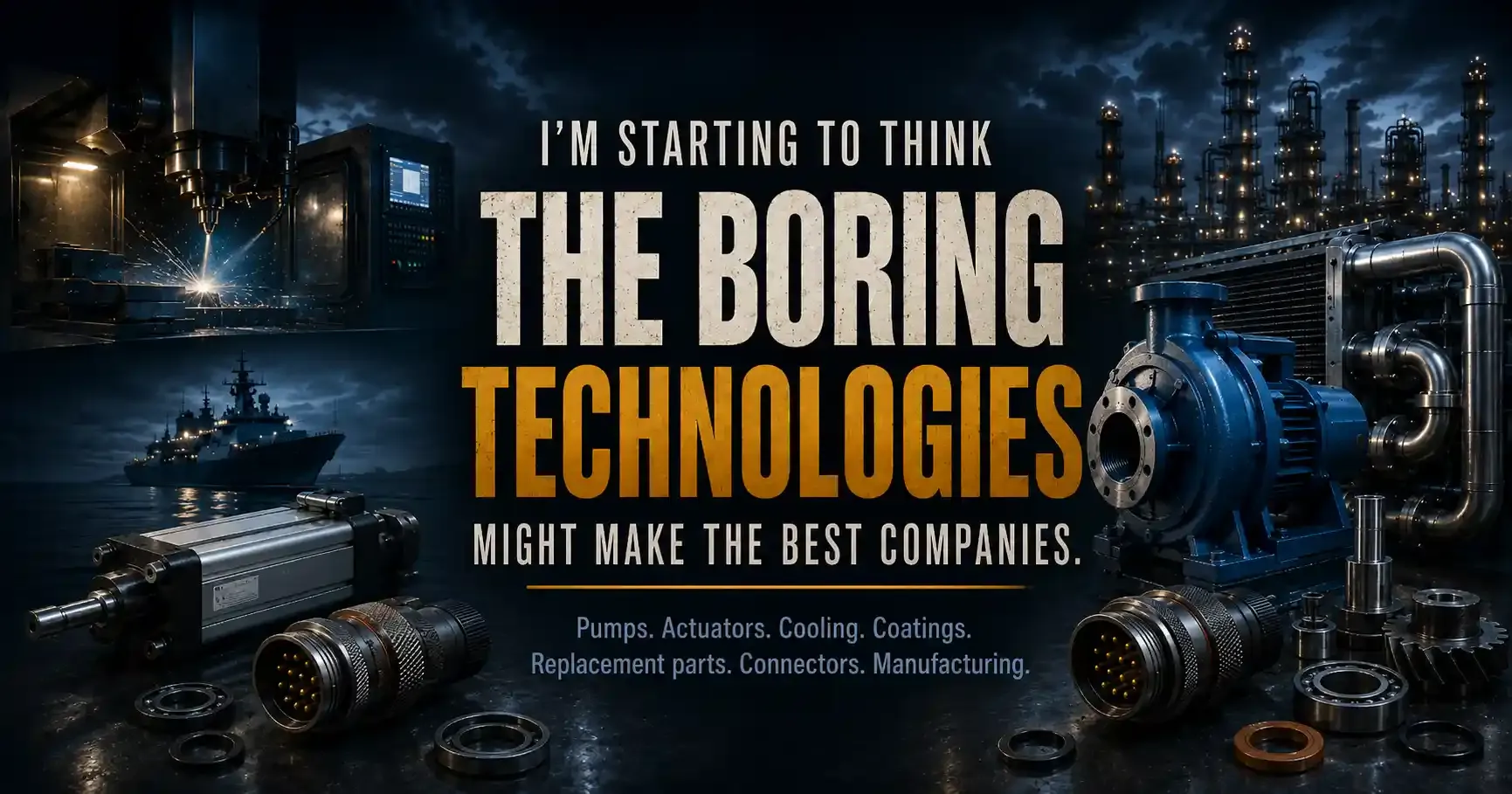
The more time I spend around deep technology, the more I find myself paying attention to things I probably would have ignored a few years ago, because while everybody naturally wants to talk about artificial intelligence, humanoid robots, autonomous vehicles, rockets, quantum computing, advanced semiconductors, and whatever technology happens to be dominating headlines that week, I keep running into enormous problems that are ultimately being caused by something much less glamorous.
A pump is failing.
An actuator is too heavy.
A cooling system cannot remove enough heat.
A coating cannot survive the environment.
A connector works perfectly in the laboratory but becomes unreliable after thousands of cycles.
A forty-year-old machine is perfectly capable of continuing to operate, except one critical replacement part is no longer manufactured.
A manufacturing process takes six hours when somebody has figured out how to make it take ninety minutes.
None of those things sound particularly exciting when you put them on a pitch deck, and I doubt we are going to see many magazine covers celebrating the world's newest industrial pump, but I am increasingly starting to think that this is exactly where some of the most interesting company-building opportunities are hiding.
The technology does not have to look revolutionary from ten feet away if the problem it solves is expensive enough.
In fact, there may be an advantage in solving problems that everybody depends on but very few people want to think about.
The Most Important Technology in the Machine Might Be the Part Nobody Notices
There is a tendency in technology to focus on the object people can see, because the finished system is what gets photographed, demonstrated, funded, and remembered, while the hundreds or thousands of components making that system possible disappear into the background.
We look at a robot and think about artificial intelligence, computer vision, autonomy, and the software telling it what to do, but that robot still needs motors, actuators, bearings, sensors, gearboxes, connectors, thermal management, power electronics, structural materials, and manufacturing processes that can repeatedly produce all of those components within acceptable tolerances.
We look at an AI data center and think about GPUs, models, and compute, while underneath all of that intelligence is an enormous physical system that has to move electricity, remove heat, circulate fluids, connect equipment, maintain uptime, and continue operating every hour of every day.
We look at an aircraft and focus on engines, avionics, weapons, or performance, while its continued availability may eventually depend on whether somebody can still manufacture a relatively uninteresting component designed decades ago.
That difference between what attracts attention and what actually keeps a system operating is becoming increasingly interesting to me, because the less visible component can sometimes have an importance completely disproportionate to its cost or complexity.
A $10 million machine does not become useful because 99.9 percent of its parts work.
If the missing 0.1 percent prevents the machine from operating, that tiny component temporarily has the economic importance of the entire system.
That is a very different way to look for companies.
Instead of always asking, “What new machine should exist?”, I am starting to ask, “What is preventing the machines we already have from working better?”
The World Runs on Technologies We Almost Never Talk About
Pumps are a perfect example because they are about as far from fashionable technology as you can get, yet they sit underneath chemical plants, factories, water systems, power facilities, cooling systems, oil and gas operations, semiconductor facilities, food processing, buildings, and countless other pieces of industrial infrastructure.
The U.S. Department of Energy has estimated that pumping systems account for roughly 25 percent of the energy consumed by electric motors in the U.S. industrial sector, and in industries that rely heavily on pumping, they can account for more than half of electricity consumption. DOE continues to maintain tools and guidance specifically for improving pumping-system efficiency because relatively ordinary changes in how pumps are selected, controlled, and operated can create meaningful energy and operating savings.
Nothing about that sounds like science fiction, but if you can make a pumping system significantly more efficient, reliable, compact, resistant to failure, easier to manufacture, or capable of operating somewhere conventional pumps cannot, you may have created something economically important.
The same argument applies to corrosion and coatings, another category that most people outside industrial operations probably spend almost no time thinking about until something rusts, leaks, breaks, or needs to be replaced.
The Association for Materials Protection and Performance estimates that the global economic cost of corrosion exceeds $2.5 trillion annually and says established corrosion-control practices could potentially avoid between 15 and 35 percent of those costs, which means there is an enormous economic system built around preventing ordinary materials from slowly destroying themselves.
A coating that allows an offshore structure, pipeline, ship, aircraft component, heat exchanger, or industrial asset to operate materially longer before maintenance may not appear transformative when you look at the coating itself, but the value is not in how impressive the material looks.
The value is in what does not have to happen because the coating worked.
The equipment does not have to be taken offline.
The structure does not have to be replaced.
The maintenance crew does not have to be dispatched.
The production line does not have to stop.
The operator does not have to absorb an avoidable failure.
That is a pattern I keep noticing in industrial technology: the product can look small while the avoided problem is enormous.
AI Is Making Physical Infrastructure More Important, Not Less
One reason I think these opportunities are becoming more interesting now is that the world's obsession with software and AI is creating extraordinary new demands on physical infrastructure, which means technologies that might once have been considered supporting equipment are becoming strategic constraints.
Data centers illustrate this perfectly because everyone wants more compute, but every additional accelerator ultimately becomes another physical object consuming electricity and generating heat that has to go somewhere.
The U.S. Department of Energy reported that data centers consumed approximately 4.4 percent of total U.S. electricity in 2023 and projected that the share could rise to between 6.7 and 12 percent by 2028, with total electricity consumption potentially reaching between 325 and 580 terawatt-hours. DOE also emphasizes that reliable cooling is essential because servers cannot simply continue operating indefinitely while their heat density rises.
That means the AI infrastructure opportunity is not limited to whoever designs the next GPU.
It exists in power conversion.
It exists in transformers.
It exists in cooling.
It exists in pumps.
It exists in heat exchangers.
It exists in thermal interface materials.
It exists in liquid distribution.
It exists in connectors.
It exists in sensors.
It exists in manufacturing.
It exists anywhere the physical infrastructure becomes the limiting factor preventing more compute from being deployed.
The software may get the attention, but the physical bottleneck still gets paid.
I think we are going to see this repeatedly as AI moves further into robotics and other physical systems, because the more intelligence we give machines, the more important their mechanical and electrical components become.
Investment in robotics and so-called physical AI has already accelerated sharply, with PitchBook data reported by Business Insider showing global robotics and physical-AI venture investment rising from roughly $4 billion in 2019 to $26 billion in 2025, while investors increasingly point to improvements in sensors, actuators, cameras, manufacturing, and other physical components as part of what is making the current generation of robotics companies possible.
A robot can have a brilliant AI model and still be a terrible product if an actuator overheats, a gearbox wears out, a battery cannot support the duty cycle, a connector becomes unreliable, or the entire machine costs so much to manufacture that no customer can justify buying it.
That is why I increasingly think the picks-and-shovels opportunities around robotics may eventually be as interesting as some of the robots themselves.
Sometimes the Business Is Not a New Machine. It Is Keeping the Old Machine Alive.
Replacement parts may be the clearest example of a boring problem becoming strategically important, because there are enormous fleets of aircraft, ships, industrial machines, power systems, vehicles, factories, and infrastructure assets that were designed to operate for decades, while many of the companies that originally manufactured their individual components were never expected to support those components forever.
The result is a strange industrial problem in which an extremely valuable machine can remain mechanically useful while becoming increasingly difficult to maintain because a $500, $5,000, or $50,000 part has disappeared from the supply chain.
The U.S. Government Accountability Office described exactly this problem in a July 2026 report on the B-52, explaining that the aircraft's age has created diminishing manufacturing sources for critical parts and that Air Force officials characterize portions of the industrial base as “cold,” meaning suppliers are no longer continuously producing some of the components the aircraft requires. GAO noted that in some cases the original manufacturers no longer exist, have changed their production, or no longer make suitable components, leaving replacement suppliers to recreate production capability, sometimes without the original technical data.
The same broader problem appears elsewhere in military sustainment, where GAO identifies obsolescence and diminishing manufacturing sources as recurring challenges affecting aircraft readiness, while aging systems remain in service far beyond the period during which their original supply chains were built.
That sounds like a supply-chain headache.
I hear a company thesis.
If thousands of valuable systems around the world are being kept alive by increasingly fragile inventories of components that nobody manufactures anymore, then reverse engineering, qualification, advanced manufacturing, material substitution, digital technical data, small-batch production, and component modernization stop looking like miscellaneous industrial services and start looking like pieces of a much larger technology platform.
The company does not necessarily need to invent a new aircraft.
Maybe the company becomes exceptionally good at manufacturing the part that prevents the aircraft from flying.
That might be boring.
It might also be indispensable.
Manufacturing Processes Can Be Products Too
I used to think about manufacturing mainly as the thing that happens after a technology has been invented, almost as though the important intellectual work happens in research and development and manufacturing simply repeats whatever the engineers already designed.
I do not think about it that way anymore.
A manufacturing process can itself be the innovation, because if a company can make something faster, with fewer process steps, at lower temperatures, using less energy, with better repeatability, with fewer specialized machines, or with less expensive materials, that improvement can change the economics of everything built on top of it.
We are already seeing this logic become important in defense manufacturing, where companies are increasingly borrowing processes and components from unrelated industries rather than assuming that every military product needs a completely bespoke production system.
Reuters reported in July 2026 that newer defense manufacturers have adapted automotive electronics, equipment used in oil and gas operations, pharmaceutical mixing processes, and additive manufacturing techniques to accelerate production of missile and rocket systems, illustrating how seemingly mundane process innovations can become strategically important when the real problem is manufacturing speed and scale rather than basic physics.
That is what makes manufacturing technology so interesting to me.
Sometimes the breakthrough is not that the product does something humanity has never done before.
Sometimes the breakthrough is that we can finally manufacture an existing capability economically enough, quickly enough, or reliably enough to deploy it at scale.
Those are two completely different forms of innovation, but both can create valuable companies.
The Best Problem Might Already Have a Budget
There is another reason I like these categories, and it has nothing to do with whether the underlying engineering is glamorous.
Many industrial problems already have money attached to them.
Companies already spend money replacing failed components.
They already spend money cooling equipment.
They already spend money fighting corrosion.
They already spend money maintaining pumps.
They already spend money procuring spare parts.
They already lose money when manufacturing lines stop.
They already pay technicians to inspect equipment.
They already carry inventory because they are afraid a critical supplier will disappear.
They already redesign products when a component becomes obsolete.
That changes the startup problem because you are not always trying to persuade someone that a new category should exist; instead, you may be competing for money the customer already spends dealing with an existing pain.
This is where I think “boring technology” can become strategically attractive.
The product might represent only a small fraction of the customer's overall system cost, while the consequence of failure can be orders of magnitude larger than the purchase price, creating what I think of as a price-to-pain asymmetry.
Nobody wants to pay unnecessarily for a connector.
But if a failed connector takes a mission-critical system offline, the conversation about what a better connector is worth changes considerably.
Nobody wakes up wanting to purchase an industrial coating.
But if the coating can materially extend the service life of a very expensive asset, the economics start somewhere other than the price of paint.
Nobody wants to replace a pump because pumps are exciting.
They replace the pump because the process depends on fluid continuing to move.
That distinction matters.
The buyer is not buying the component.
The buyer is buying uptime, throughput, reliability, energy efficiency, maintainability, availability, or service life.
This May Be Where Small Technical Improvements Become Big Businesses
The interesting thing about these technologies is that a company does not always need a tenfold scientific breakthrough to create substantial value, because when a component is deployed across enough machines or operates inside an expensive enough system, relatively modest improvements can compound into meaningful economics.
A pump that consumes less energy matters when it runs continuously.
An actuator that removes weight matters when dozens are distributed across an aircraft or robot.
A coating that adds years of service life matters when the protected structure costs millions of dollars to inspect, repair, or replace.
A cooling technology that removes more heat from the same footprint matters when compute density is constrained by temperature.
A replacement part that can be delivered in six weeks rather than eighteen months matters when the absence of that part is grounding equipment.
A manufacturing process that removes several hours from every production cycle matters when a factory repeats that process thousands of times.
This is where I think people sometimes misunderstand deep tech because they instinctively look for the scientific novelty first, when the commercial value may actually come from where the technology sits inside a system.
A technically modest improvement placed at a severe system bottleneck can be enormously valuable.
A technically extraordinary invention placed where nobody urgently needs it can struggle to become a company.
Those are not the same thing.
Investors Are Starting to Look at the Physical Economy Differently
There is some evidence that the investment world is moving in this direction as well, because industrial technology, manufacturing, defense, logistics, infrastructure, and other physical sectors are attracting dedicated venture capital that would have been much harder to find during the period when software businesses dominated the startup conversation.
Construct Capital, for example, raised a $300 million fund in 2025 specifically to invest in early-stage companies across manufacturing, logistics, critical infrastructure, transportation, defense, and energy, while the firm's founders described industrial technology as an increasingly competitive venture category.
Eclipse has built its entire investment thesis around transforming essential physical industries, arguing that sectors such as manufacturing, transportation, logistics, healthcare infrastructure, energy, and defense historically received far less technology investment than their economic importance would suggest.
I would not interpret that as proof that every industrial component company belongs in venture capital, because many do not, and there is a very important difference between building a good industrial business and building a company capable of generating venture-scale returns.
But it does suggest that the old assumption that serious technology companies have to look like software companies is weakening.
The physical world is investable again.
The question is which parts of it actually deserve a startup.
Not Every Boring Technology Makes a Great Company
This is where I have to put some boundaries around the thesis, because “boring” is not automatically synonymous with “good,” and there are plenty of industrial technologies that are boring because the market is commoditized, margins are terrible, buyers have little reason to switch, and an incumbent manufacturer can copy the improvement before a startup has time to build a business.
Industrial markets can also be brutally difficult for young companies because the customers often move slowly, qualification can take years, failures can have serious consequences, manufacturing consumes capital, field support matters, distributors and purchasing relationships can be deeply entrenched, and customers may refuse to adopt something new unless the improvement is substantial enough to justify the operational risk of changing suppliers.
A technically superior actuator is not automatically a company if every customer would have to redesign the machine around it.
A better coating is not automatically a company if the customer's certification process costs more than the expected savings.
A replacement-part manufacturer is not automatically scalable if every order requires a completely unique engineering effort.
A new cooling architecture can be impressive but commercially irrelevant if deploying it requires rebuilding the entire data center.
The boring technology becomes interesting when several things line up at the same time: the problem is expensive, the buyer knows it is expensive, the technology produces a measurable improvement, adoption does not create unreasonable new risk, the company can protect or compound its advantage, and there are enough customers with the same underlying problem to build repeatable economics.
That is a much higher bar than simply finding an old industry and adding technology to it.
I Think the Real Opportunity Is in Bottlenecks
If I were searching systematically for these companies, I would not begin with a list of technologies.
I would begin with bottlenecks.
What part keeps failing?
What part has a twelve-month lead time?
What material cannot tolerate the required temperature?
What component weighs too much?
What subsystem consumes too much power?
What maintenance operation requires disassembling half the machine?
What process still depends on one highly specialized technician?
What replacement part has only one supplier?
What supplier announced an end-of-life notice?
What process is limiting factory throughput?
What piece of equipment is forcing an entire system to run below its theoretical capability?
Those questions are much more interesting to me than asking what technology category is currently fashionable, because a bottleneck gives the technology somewhere to land.
Once you identify the bottleneck, you can search for the science, intellectual property, manufacturing process, software, material, or architecture capable of removing it.
That reverses the normal deep-tech conversation.
Instead of beginning with:
“Look at this incredible technology. Where could we use it?”
You begin with:
“Here is an expensive problem. What technology could eliminate it?”
I increasingly prefer the second one.
The Economics Should Show Up in the Customer’s Operation
For these companies, I also think the economic case has to be unusually concrete, because an industrial customer is generally not buying the promise of a future lifestyle or the novelty of being an early adopter.
The customer wants to know what changes inside the operation.
Does the machine last longer?
Does it consume less energy?
Does throughput increase?
Does maintenance frequency fall?
Does the system become lighter?
Does the operating temperature improve?
Does a technician need fewer hours to repair it?
Can the customer eliminate inventory?
Can the factory manufacture twice as many units?
Can the operator keep an aging system working for another decade?
Can a domestic supplier replace a fragile overseas source?
Can an obsolete component be recreated without redesigning the entire platform?
Those are measurable questions.
DOE's work on industrial pumping systems is a good example of how seemingly ordinary engineering improvements can translate directly into operating economics, because the agency specifically frames pump-system optimization around energy savings, efficiency, maintenance, and profitability rather than around the novelty of the pump itself.
Corrosion provides the same lesson at much larger scale, because AMPP's estimate that existing corrosion-management practices could avoid a meaningful portion of the world's estimated $2.5 trillion annual corrosion burden shows that a company does not necessarily have to eliminate corrosion to create value; moving the failure curve enough to reduce inspection, maintenance, downtime, and replacement can already matter economically.
The right metric is not how sophisticated the technology sounds.
The right metric is what changes when the customer installs it.
What I Would Want to See Before Calling One of These a Company
If somebody brought me one of these technologies today, there are a few milestones I would care about much more than whether the product photographs well.
I would want to see it operating inside the environment where it is actually supposed to work rather than only on a laboratory bench, because industrial technology becomes interesting when heat, vibration, dust, pressure, moisture, duty cycles, imperfect operators, maintenance schedules, and real production conditions begin attacking it.
I would want a customer to quantify the improvement, whether that means lower energy consumption, higher force density, longer operating life, reduced maintenance, shorter lead times, fewer parts, lower manufacturing temperatures, better thermal performance, or some other metric directly connected to the customer's economics.
I would want to know how difficult qualification is, how long the sales cycle will be, whether the technology can be manufactured repeatedly, whether there is a second application beyond the first customer, and whether the company becomes more valuable as it deploys more units through proprietary data, manufacturing knowledge, certification, customer integration, intellectual property, service infrastructure, or some other accumulating advantage.
Most importantly, I would want to know whether the customer cares enough about the problem to buy the product now.
That last part sounds obvious, but deep tech makes it very easy to become fascinated with a solution before proving that the problem underneath it is urgent.
The Best Deep-Tech Company Might Not Look Like Deep Tech at First
I am starting to think there is a category of company that is easy to overlook because the technology does not immediately announce itself as revolutionary.
It may manufacture an actuator.
It may improve a pump.
It may develop a coating.
It may solve a thermal-management problem.
It may make a connector that works in an environment where existing connectors fail.
It may reverse engineer parts nobody has manufactured for thirty years.
It may develop a manufacturing process that cuts production time in half.
It may never become a household name.
But the customers using it may consider it absolutely essential.
There is something attractive about that kind of company because the value proposition can become very simple: something important does not work well enough today, and after installing this technology, it works better.
No grand theory is required.
No category has to be invented.
No customer needs to be convinced that the underlying problem exists.
The problem is already sitting inside the factory, aircraft, robot, data center, ship, power plant, or piece of infrastructure, costing somebody money.
That is starting to look like a very good place to build.
The Bottom Line
I still love the technologies that make you stop and stare, because there is something extraordinary about watching a new capability appear that genuinely did not exist before, and I do not think we should stop chasing those breakthroughs.
What has changed for me is that I no longer assume the most visually impressive technology represents the most interesting company opportunity.
The physical world is full of systems that already exist, already have customers, already have budgets, and already contain expensive bottlenecks, and many of those bottlenecks come down to technologies that sound almost painfully ordinary until you understand what happens when they fail.
Pumps.
Actuators.
Cooling.
Coatings.
Connectors.
Replacement parts.
Manufacturing processes.
None of them need to be exciting by themselves.
They need to solve something expensive.
The more time I spend around deep tech, the more I think that distinction matters, because the best company may not always be the one building the machine everybody wants to photograph.
Sometimes the better company is building the part that makes the machine work.
Frequently Asked Questions
What is a “boring technology”?
I am using the term to describe technologies that are critically important to physical systems but rarely receive much public attention, including pumps, actuators, thermal-management equipment, connectors, coatings, replacement parts, industrial materials, manufacturing processes, and other enabling components. “Boring” does not mean technically simple or unimportant; in many cases these technologies involve sophisticated engineering but remain mostly invisible to anyone outside the industry using them.
Why can boring industrial technologies make good businesses?
They can become attractive businesses when they solve an expensive and recurring operational problem, particularly when the technology affects uptime, energy consumption, maintenance, throughput, equipment life, supply-chain availability, or some other metric the customer already measures financially. The strongest opportunities often arise when the component represents a relatively small portion of total system cost but its failure has disproportionately large consequences.
What are examples of overlooked deep-tech opportunities?
Potential categories include industrial pumps, electric motors and actuators, data-center cooling, heat exchangers, advanced coatings, corrosion protection, high-reliability connectors, obsolete replacement parts, specialty materials, advanced joining, inspection technologies, test equipment, power electronics, manufacturing equipment, and process improvements that reduce time, cost, energy, or complexity.
Why is data-center cooling becoming such a large technology problem?
AI infrastructure is increasing both electricity demand and the amount of heat that must be removed from increasingly dense computing equipment. The U.S. Department of Energy estimates data centers accounted for about 4.4 percent of U.S. electricity consumption in 2023 and projects that they could account for 6.7 to 12% by 2028, making power and thermal management increasingly important constraints on additional computing capacity.
Why are obsolete replacement parts an opportunity?
Long-lived equipment can remain useful long after its original component suppliers stop manufacturing particular parts, creating situations where an otherwise operational aircraft, ship, industrial machine, or infrastructure system becomes difficult to maintain. GAO continues to identify obsolescence and diminishing manufacturing sources as sustainment challenges in U.S. military fleets, including the B-52.
What makes an industrial component startup defensible?
Defensibility can come from patents, proprietary materials, specialized manufacturing processes, qualification and certification, customer integration, field-performance data, difficult-to-reproduce process knowledge, supply-chain control, or an installed base that becomes increasingly expensive for customers to replace. The exact moat depends on the product, and technical novelty by itself is not necessarily enough.
What is the biggest risk with industrial technology startups?
One of the largest risks is developing a technically superior product without creating enough economic value to justify customer adoption, because industrial buyers often face qualification costs, operational risk, long procurement cycles, established supplier relationships, and expensive redesign requirements. A strong industrial startup therefore needs both technical advantage and a credible path into the customer's existing system.
Is every industrial technology suitable for venture capital?
No. An industrial technology can produce a strong, profitable company without having the market size, growth rate, repeatability, or economics necessary for traditional venture capital. Venture-scale opportunities usually require a problem that repeats across many customers or applications and a business model capable of scaling faster than a purely customized engineering service.
Sources
- U.S. Department of Energy, industrial pumping systems and energy efficiency.
- U.S. Department of Energy, U.S. data-center electricity demand and cooling requirements.
- U.S. Government Accountability Office, 2026 B-52 sustainment and diminishing manufacturing sources.
- U.S. Government Accountability Office, 2026 military aircraft readiness and parts obsolescence.
- Association for Materials Protection and Performance, global corrosion costs and corrosion-management savings.
- Reuters, 2026 defense manufacturing and cross-industry process innovation.
- Eclipse, investment thesis around essential physical industries.
- The Wall Street Journal, industrial-technology venture investment and Construct Capital's $300 million fund.
No spam, no sharing to third party. Only you and me.