Space Traffic Management (STM) Needs Execution Governance, Not Just Situational Awareness

Space is getting crowded.
That sentence has been repeated for years, but the underlying reality is accelerating. Mega-constellations, rideshare launches, small satellite proliferation, and active debris removal are pushing low Earth orbit into a new operational regime.
The industry response so far has focused on one core capability:
Situational awareness.
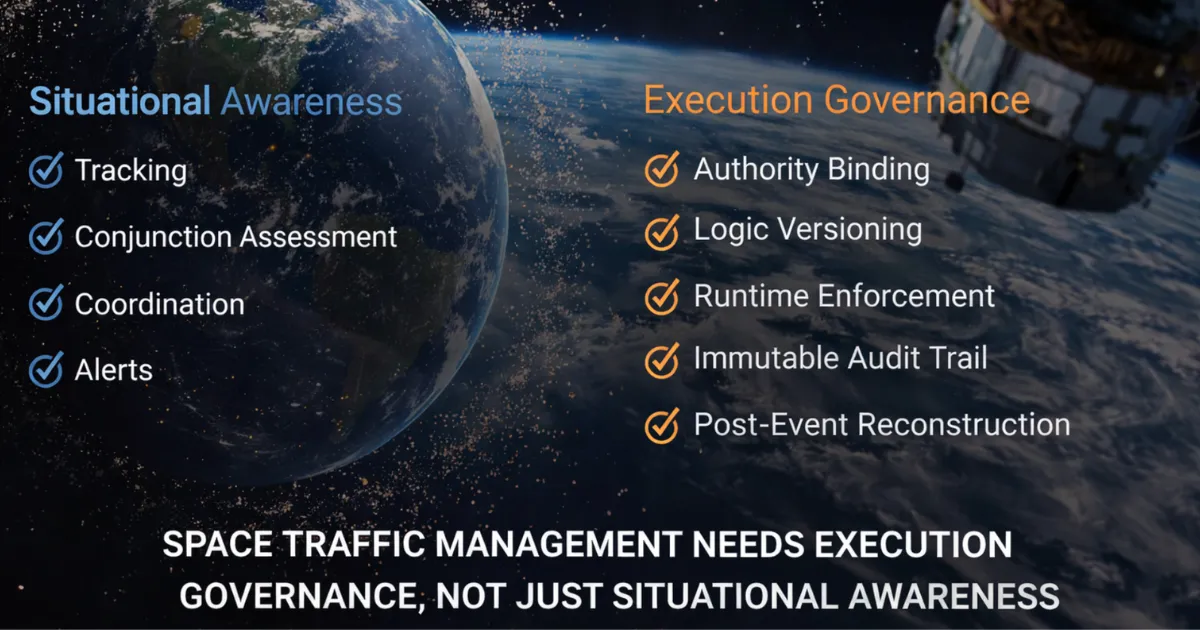
We have improved tracking.
We have improved conjunction assessment.
We have improved data sharing.
We have improved alerting.
Companies like LeoLabs, NorthStar Earth & Space, and COMSPOC are building increasingly sophisticated systems to detect potential collisions and inform operators.
This is essential.
But awareness is not the same as assurance.
There is a structural gap emerging in the STM ecosystem.
When a conjunction alert is generated and a maneuver is recommended, several critical questions remain:
Who had authority to execute that maneuver?
Which version of the maneuver logic was active?
Was the autonomous system operating inside declared policy bounds?
Can the exact configuration that executed the maneuver be reconstructed later?
If something goes wrong, can responsibility be attributed precisely?
Today, most STM discussions focus on data exchange, coordination frameworks, and shared operating pictures.
Very few focus on runtime execution governance.
That distinction matters.
As satellite constellations scale and autonomy increases, more maneuver decisions will move from human-in-the-loop to human-on-the-loop, and eventually to machine-initiated responses under predefined policy constraints.
When that happens, execution integrity becomes as important as prediction accuracy.
Consider a future scenario.
An STM supplier issues a high-confidence conjunction alert.
A maneuver is recommended.
An autonomous system executes within seconds.
A downstream anomaly occurs.
Even if the alert was correct, investigators will not only examine the prediction.
They will examine execution.
Was the maneuver authorized?
Was the software version certified?
Was the system operating within regulatory constraints?
Was the execution trace tamper-proof?
Was the decision path auditable?
Without execution-layer governance, the STM ecosystem risks becoming strong at coordination but weak at accountability.
And accountability is what insurers, regulators, and operators ultimately care about.
The next phase of space traffic management is not just better tracking.
It is governed execution.
That means:
Binding maneuver authority explicitly.
Locking logic versions at time of execution.
Enforcing behavioral envelopes at runtime.
Generating immutable audit records.
Enabling post-event reconstruction at system level.
Situational awareness tells us what might happen.
Execution governance proves what did happen.
As civil STM frameworks evolve and responsibility shifts beyond defense institutions, the need for accountable, decentralized execution infrastructure will grow.
Space traffic management is moving from awareness to automation.
Automation without governance scales risk.
Governance embedded at runtime scales trust.
The industry has built impressive sensing and analytics layers.
The next layer is assurance.
And assurance lives at execution time.
No spam, no sharing to third party. Only you and me.