America Can Invent Almost Anything. Why Can’t We Build It Here?


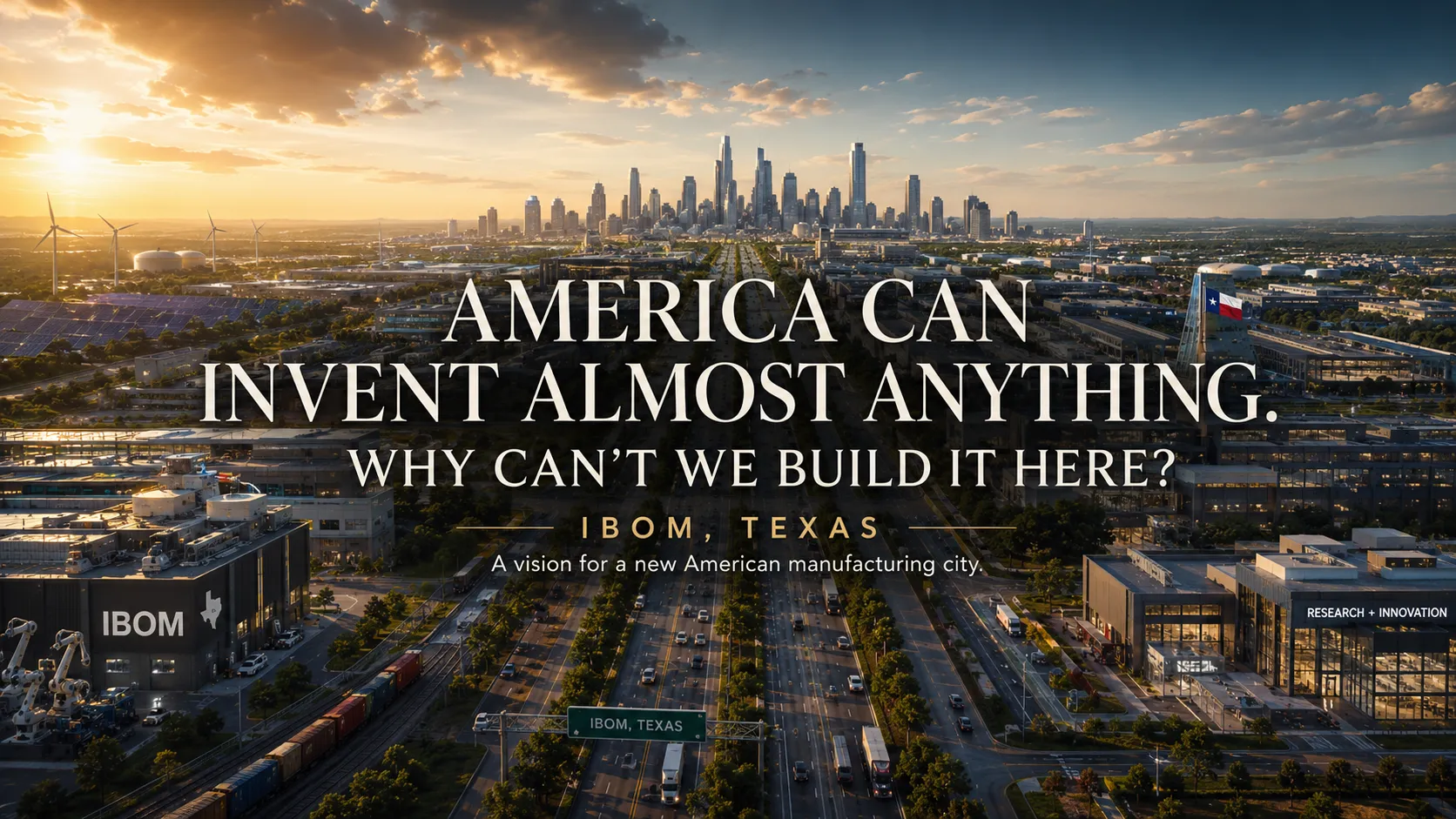
This is a thought experiment. Ibom is not an announced development, an approved city, or a government program. It is my attempt to think through what I believe an American manufacturing ecosystem should look like if we were willing to design one deliberately for the next hundred years.
America can invent some of the most advanced technologies in the world, but we still struggle to manufacture many of them at scale.
That contradiction has been bothering me for a while.
We have extraordinary universities. We have national laboratories. We have engineers and scientists who can push the boundaries of physics, materials science, biotechnology, computing, robotics and aerospace. We have one of the deepest venture-capital markets in the world. We can create a new semiconductor architecture, develop an autonomous system, prototype a surgical device, design an advanced sensor or discover an entirely new material.
Then comes the question that sounds simple until you actually try to answer it:
Where are we going to manufacture it?
Suddenly, everything becomes complicated.
The semiconductor might come from one state or one country. Packaging happens somewhere else. The printed circuit board comes from another supplier. The specialty coating may be several states away. The battery cells may originate overseas. The rare-earth magnet may depend on refining thousands of miles from the factory. The optical component has another supplier. The enclosure comes from somebody else. The testing laboratory is in another region. Final assembly happens somewhere entirely different.
You do not have a supply chain.
You have a scavenger hunt.
And every company trying to build a physical product ends up creating its own version of that scavenger hunt.
The fragmentation is not merely inconvenient. It creates time, cost, inventory, qualification, transportation, cybersecurity and national-security problems. In 2025, the U.S. Government Accountability Office reported that the Department of Defense lacked a coordinated, holistic framework for managing risks across its broader supply chain, and that those risks were being managed across numerous organizations with limited cross-functional coordination. The same report described continuing difficulty seeing far enough into lower tiers of the supplier network to understand the origin of critical materials and components.
That is the part I cannot stop thinking about.
America does not have an invention problem.
We have a translation problem between invention and production.
And maybe one answer is not another grant program, another accelerator or one more giant factory standing by itself.
Maybe one answer is geography.
Shenzhen Changed the Way I Think About Manufacturing
When I began looking more closely at Shenzhen, something clicked.
Shenzhen is obviously famous for electronics manufacturing, but describing it as a place that “makes electronics” misses the point. The city and the larger industrial region surrounding it have spent decades developing density across semiconductors, communications, electronics, sensors, robotics, batteries, manufacturing equipment, materials, medical technology and thousands of supporting suppliers.
Shenzhen’s own industrial policy reflects how broad that ecosystem has become. Its strategic clusters include semiconductors and integrated circuits, network and communications equipment, intelligent terminals, intelligent sensors, machine tools, robotics, laser and additive manufacturing, precision instruments, new energy, environmental technology, new materials, medical equipment and biomedicine. The city also identifies synthetic biology, aerospace, optical computing and quantum information among its future industries.
In 2024, Shenzhen reported double-digit growth in the value added of several of those industrial clusters, including semiconductors, new energy, robotics and aerospace-related industries.
By 2026, Shenzhen was describing advanced manufacturing and its high-tech innovation ecosystem as fundamental to its enormous foreign-trade performance.
That is what makes the place interesting to me.
It is not just factories.
It is the distance between the factories.
Imagine that you are building a drone.
You need a processor, RF electronics, sensors, cameras, motors, motor controllers, batteries, antennas, connectors, a PCB, a composite structure, machined components and software. You also need tooling, testing, packaging and somebody who understands how to make the product repeatably.
If every one of those things requires a relationship with a company in a different state, country or time zone, every design change creates another coordination problem.
If many of those capabilities live in the same industrial ecosystem, something different happens.
Your motor supplier may know the bearing company.
The PCB assembler has already worked with your connector vendor.
The injection-molding company understands the tolerance issue because it has solved a similar problem for three other customers.
The component distributor has the alternative part in inventory.
The testing laboratory is twenty minutes away.
A failed prototype does not automatically mean another month.
That is industrial density.
Economists usually describe some of these benefits through agglomeration and industrial clustering. The OECD notes that regional clusters can strengthen competitiveness by bringing firms, research institutions, universities and other organizations together around complementary economic activities.
I think we have underestimated how important that physical density is.
We built the Internet as though distance no longer mattered.
For software, distance sometimes matters very little.
For physical systems, distance still matters a lot.
I Am Not Talking About Copying China
Whenever someone says, “America needs something like Shenzhen,” the easiest interpretation is that we want to copy Shenzhen.
I do not.
I would take one lesson from Shenzhen very seriously: concentrate complementary industrial capabilities close enough together that they reinforce one another.
Everything else should be designed for American conditions.
We have higher labor costs. Instead of treating that as a permanent disadvantage, build factories around automation from the beginning.
We have different environmental standards. Design the industrial geography so heavy processing, clean manufacturing, residential development and biotechnology are appropriately separated.
We have extraordinary universities. Put them physically into the ecosystem.
We have some of the world’s deepest capital markets. Build financial structures that let startups access manufacturing without owning every machine.
We have national-security requirements that make provenance and traceability increasingly important. Build those requirements into the supply chain rather than trying to audit them five years later.
We have an enormous domestic market and access to trusted allies. Use both.
Most importantly, do not attempt to recreate the labor economics of yesterday’s China while China itself is investing heavily in robotics and automated manufacturing.
The American model should be based on productivity.
My sourcing philosophy would be simple:
Domestic first. Trusted allies second. Strategic foreign sourcing where necessary. Adversarial dependency last.
That does not mean every screw must be manufactured in Texas.
It means that for critical systems we should understand where the dependency lives, whether an alternative exists, and what would happen if that source disappeared tomorrow.
America Is Already Starting to Think in This Direction
I originally thought this idea sounded almost too ambitious until I started looking at what other people are already proposing.
In 2025, Reuters reported that SoftBank founder Masayoshi Son was exploring a potential $1 trillion industrial complex in Arizona centered on robotics and artificial intelligence. What caught my attention was that the reported objective was specifically to bring high-end manufacturing back to the United States and create something resembling China’s Shenzhen manufacturing hub. Reuters reported that SoftBank had discussed the concept with federal and state officials and was sounding out potential technology partners. The project was still preliminary, but the basic idea was already being discussed at an extraordinary scale.
There is another example in California.
California Forever is currently proposing the Solano Foundry, a 2,100-acre advanced-manufacturing campus with 40 million square feet of manufacturing space. Its stated sectors include robotics, energy, advanced transportation and defense, with production, research, training, freight infrastructure and residential development planned in proximity to one another. The developers explicitly argue that putting R&D near manufacturing can accelerate iteration and that infrastructure and entitlements need to be designed before individual factories arrive.
Whether either project develops exactly as envisioned is almost beside the point for this essay.
The important thing is that the idea of building large, deliberate industrial ecosystems in America is no longer science fiction.
People are asking the same underlying question:
What happens if we stop treating factories as isolated real-estate projects and start treating manufacturing as an ecosystem?
My version simply goes further.
I do not want an industrial park with housing nearby.
I want a city whose economic reason for existing is the design and production of physical technology.
Why I Would Put Ibom in Central Texas
Once I began thinking about the city seriously, the next question became obvious.
Where?
You could make a case for Arizona. You could make a case for parts of Ohio, Tennessee, Georgia, North Carolina or upstate New York. Each has real advantages.
I keep coming back to Central Texas because several things are already converging there.
Texas has one of the most substantial semiconductor manufacturing footprints in the country. Samsung operates its long-standing Austin fab and is developing its Taylor manufacturing site. NXP operates semiconductor manufacturing facilities in Austin. Applied Materials says Austin is home to its largest manufacturing and logistics facility. Texas has also built a state semiconductor incentive and research structure through the Texas Semiconductor Innovation Fund and Texas CHIPS initiatives.
That does not mean Ibom should be another semiconductor cluster.
It means semiconductors give us industrial gravity.
If you are going to build a broad physical-technology city, it helps enormously to start close to an existing concentration of engineers, suppliers, equipment companies, research institutions and manufacturers.
Austin gives us that.
But I would not put Ibom in Austin.
I would go southeast.
Why the Lockhart-Luling Corridor Keeps Making Sense
The corridor around Lockhart and toward Luling in Caldwell County is interesting because it gives us access to Austin without requiring us to build a massive new industrial city inside Austin itself.
According to the Lockhart Economic Development Corporation, Lockhart is approximately 35 miles from Austin and 65 miles from San Antonio. US Highway 183 runs directly through the area. State Highway 130 runs about five miles east of downtown Lockhart. Interstate 35 is roughly 20 miles away, Interstate 10 about 10 miles away, and Austin-Bergstrom International Airport about 25 miles away. Union Pacific provides freight-rail service.
Then look at the ports.
The same local economic-development data places Lockhart approximately 156 miles from the Port of Houston and 166 miles from the Port of Corpus Christi.
Port Houston is not a minor regional port. The Houston Ship Channel complex is the largest U.S. port complex by waterborne tonnage, while Port Houston describes itself as the largest Gulf Coast container port, handling about 75 percent of Gulf Coast container traffic.
So think about the geography.
To the north, Austin.
To the southwest, San Antonio.
To the east, Houston.
To the southeast, Corpus Christi.
US 183.
SH 130.
I-10.
I-35.
Rail.
International airport.
Gulf ports.
And enough distance from downtown Austin that we could at least contemplate something much larger than another hundred-acre business park.
This does not prove Caldwell County is the final answer. Before anything real happened, you would have to study land assembly, water, transmission capacity, environmental constraints, community support, flood risk, geology, utility rights-of-way, workforce, housing, rail capacity and dozens of other factors.
But as a first-pass location hypothesis, I find the corridor extremely compelling.
There is another reason.
It is already inside a Foreign-Trade Zone service area.
The Foreign-Trade Zone May Be One of the Most Important Pieces
Caldwell County is within the federally approved service area of Foreign-Trade Zone 183, the Foreign Trade Zone of Central Texas.
The official federal database lists Bastrop, Caldwell, Hays, Travis and Williamson counties inside FTZ 183’s service area. The zone is active, and Samsung Austin Semiconductor operates an active subzone within it. Flextronics also appears as an active subzone.
That is important because Ibom should not be designed only for domestic consumption.
I want companies to manufacture in America and export from America.
A Foreign-Trade Zone helps make that model more competitive.
The U.S. Department of Commerce describes FTZs as designated U.S. locations where companies can use special customs procedures that encourage American activity and value creation. Imported merchandise can enter an activated zone before ordinary customs duty is paid. If that merchandise later enters the U.S. market, duties are generally paid then. If foreign components are incorporated into products that are subsequently exported, U.S. duty generally is not paid on the value of those foreign components. FTZ users may also qualify for streamlined customs procedures such as weekly entry, while foreign goods and domestic goods held for export can receive exemption from state and local inventory taxes.
That could matter enormously.
Imagine a medical-device company in Ibom requires a precision optical assembly from Germany because no equivalent domestic supplier exists yet.
The component enters the FTZ.
Ibom adds American engineering, electronics, manufacturing, software, testing, packaging and labor.
The finished device is exported to Singapore.
The objective of the FTZ structure is to avoid making American production less competitive simply because the foreign component had to cross the U.S. border before the final product left the country again.
The same principle could apply to specialized Japanese robotics components, Korean battery inputs or advanced equipment manufactured by trusted partners.
And over time, Ibom should be trying to replace some of those imports with companies inside the ecosystem.
That is how I see the FTZ.
Not as a permanent import strategy.
As a bridge.
No, a Foreign-Trade Zone Does Not Mean “Tax-Free”
This distinction matters because “Foreign-Trade Zone” can sound like some kind of sovereign tax haven.
It is not.
Ibom would still be in Texas.
Federal law still applies.
State law still applies.
Local law still applies.
Labor law still applies.
Environmental law still applies.
The Commerce Department explicitly states that FTZ sites remain within the jurisdiction of local, state and federal governments and that only the special customs procedures change.
Even the FTZ itself is not automatic simply because Caldwell County is inside FTZ 183’s service area.
A particular facility still needs the appropriate FTZ designation and activation. Customs and Border Protection must activate the site before zone operations begin. Manufacturing involving foreign-status components requires separate production authority from the FTZ Board.
So I would not market Ibom as “tax-free.”
That would be inaccurate.
Texas does not impose a personal state income tax or a conventional corporate income tax, which is certainly attractive, but businesses may still be subject to Texas’ franchise tax. Texas also imposes a 6.25 percent state sales and use tax, and local jurisdictions can add up to another 2 percent, producing a maximum combined rate of 8.25 percent. The state’s current franchise-tax no-tax-due threshold is $2.65 million for the 2026 and 2027 report years.
The pitch should be more sophisticated than “no taxes.”
It should be:
Competitive tax structure + FTZ customs treatment + infrastructure + suppliers + talent + speed + power + export access.
That is a much harder advantage for another region to copy.
Ibom Cannot Be a Semiconductor City
Semiconductors matter enormously.
But if this idea becomes “let’s build another chip city,” we will have missed the larger opportunity.
A semiconductor is valuable because it goes into something.
A robot.
A medical device.
A communications system.
A power converter.
A drone.
A sensor.
A laptop.
A satellite terminal.
An industrial machine.
A car.
A piece of laboratory equipment.
The real opportunity is to put the semiconductor company close to the industries that consume semiconductors.
Then put those companies close to the industries that make their other inputs.
That is how the ecosystem begins feeding itself.
A robotics company needs sensors.
The sensor company needs semiconductor devices and coatings.
The drone company needs batteries, motors, optics and communications.
The medical-device company needs electronics, sensors, precision manufacturing and polymers.
The environmental company needs pumps, membranes, sensors and controls.
The battery company needs power electronics and materials.
The communications company needs RF semiconductors, antennas, connectors and precision test equipment.
One factory becomes another factory’s customer.
That is the flywheel.
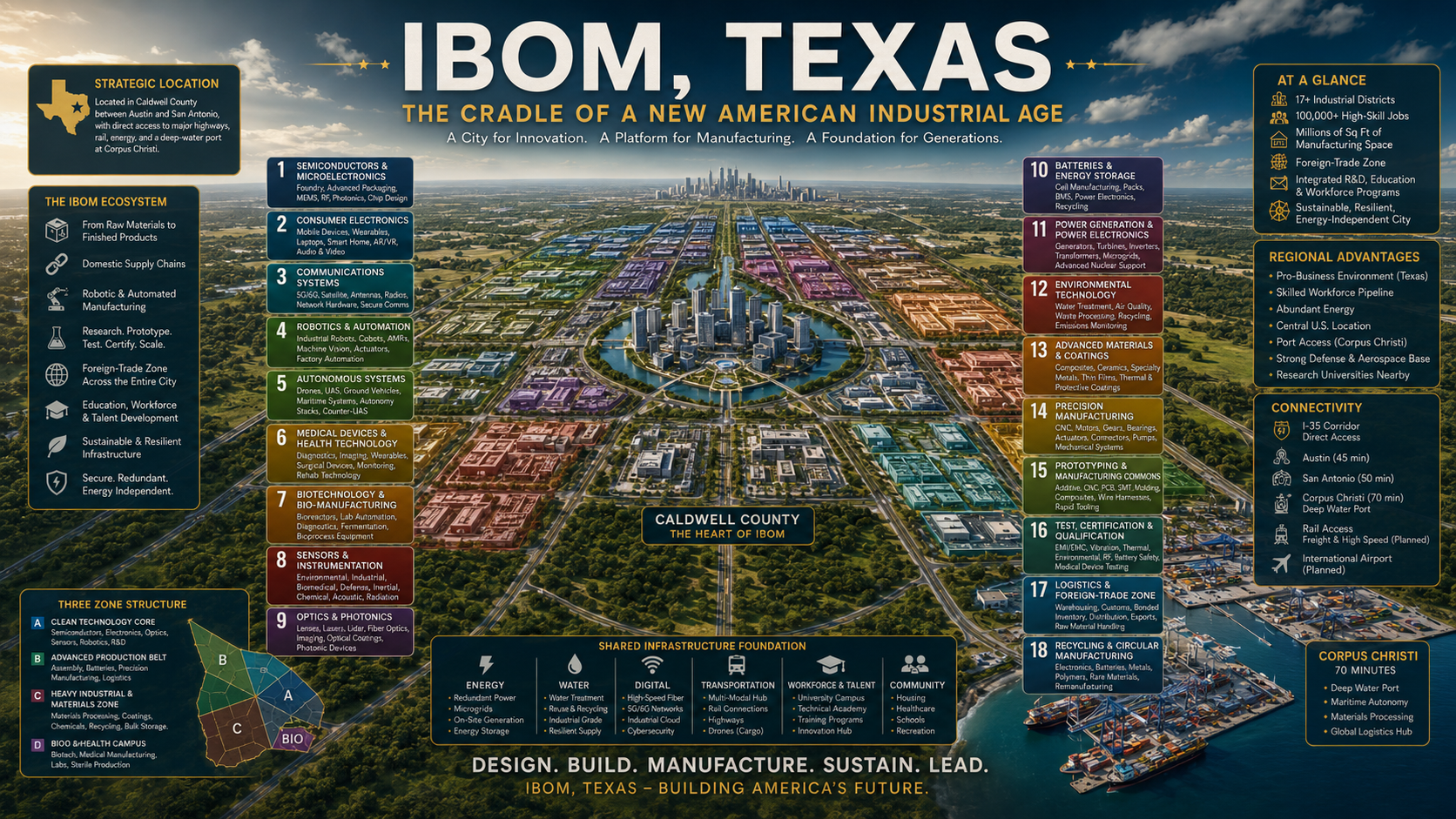
Why the image belongs here
Everything above this point explains why I think the city should exist and why Central Texas could make sense.
Everything below this image explains what would actually be inside the city.
The Industrial Districts of Ibom
I would not organize Ibom around one “technology park.” I would create specialized production districts designed around industries that share suppliers, research capabilities, infrastructure and customers.
The exact boundaries would obviously change as the project matured, but conceptually I see at least eighteen major industrial districts.
1. Semiconductors and Microelectronics
This district would cover wafer fabrication, MEMS, RF, power semiconductors, advanced packaging, chiplets, substrates, test, semiconductor equipment, specialty chemicals and related microelectronics.
Central Texas already gives the idea a meaningful head start. Samsung has Austin and Taylor manufacturing operations, NXP operates wafer manufacturing in Austin, and Applied Materials has major manufacturing and logistics capability in the region.
But the important design choice would be to connect the semiconductor district directly to customers across the rest of Ibom.
2. Consumer Electronics
I want phones.
Tablets.
Laptops.
Wearables.
Cameras.
Smart-home equipment.
AR and VR systems.
Personal audio.
Gaming hardware.
Rugged electronics.
Industrial handheld devices.
Why?
Because consumer electronics create volume, and volume changes supplier economics.
If a defense program needs 3,000 connectors, that may not justify a connector manufacturer building in Ibom.
If medical devices, robots, phones, networking systems, drones and industrial products collectively need 30 million connectors, the conversation changes.
Consumer production is not a distraction from strategic manufacturing.
It can help finance the supplier base strategic manufacturing needs.
3. Communications and Connectivity
This district would manufacture radios, antennas, RF modules, network equipment, fiber systems, satellite terminals, private-network infrastructure, secure communications, edge networking and future 5G and 6G equipment.
Communications hardware intersects with almost everything else in the city.
The drone needs it.
The robot needs it.
The autonomous vehicle needs it.
The factory needs it.
The medical network needs it.
The power grid needs it.
The city itself becomes a test environment for the products.
4. Robotics and Automation
This district is fundamental because the companies here would help build the factories everywhere else.
Industrial robots.
Cobots.
Autonomous mobile robots.
Machine vision.
Industrial controllers.
Servos.
Grippers.
Automated material handling.
Factory orchestration.
Robotic welding.
Inspection systems.
Humanoid systems where useful.
Shenzhen itself now reports a very large robotics ecosystem, with city sources saying more than 70,000 companies participate across its robotics industry chain.
America should not respond by trying to recreate labor-intensive manufacturing.
We should respond by trying to lead the next generation of manufacturing automation.
5. Autonomous Systems
Drones would be one part of this district, but not the whole thing.
Uncrewed aircraft.
Ground robots.
Autonomous trucks.
Warehouse vehicles.
Agricultural systems.
Maritime autonomy.
Inspection systems.
Counter-UAS.
Autonomous construction equipment.
These products are essentially integration engines. They combine batteries, communications, sensors, semiconductors, optics, motors, controls, composites and software.
That makes autonomous systems a perfect customer for the rest of Ibom.
6. Medical Devices and Health Technology
This deserves its own district.
Diagnostic systems.
Surgical robotics.
Patient monitoring.
Wearables.
Imaging equipment.
Implantable electronics.
Respiratory equipment.
Rehabilitation technology.
Laboratory instruments.
Remote health devices.
This district would sit close to sensors, optics, electronics, robotics and precision manufacturing because those industries share enormous amounts of underlying technology.
7. Biotechnology and Biomanufacturing
Biotechnology should be adjacent to health technology but physically engineered as its own controlled environment.
Wet laboratories.
Bioreactors.
Fermentation.
Diagnostics.
Biosensors.
Lab automation.
Cold-chain logistics.
Sterile production.
Bioprocessing equipment.
Synthetic-biology infrastructure.
The important point is that an advanced manufacturing city cannot treat biotech as though it were just another warehouse tenant.
The infrastructure is different.
The contamination controls are different.
The waste systems are different.
The utility requirements are different.
So the city should be designed accordingly.
8. Sensors and Instrumentation
I think this could quietly become one of the most important districts in Ibom.
Pressure sensors.
Temperature.
Chemical.
Biological.
Inertial.
Acoustic.
Radiation.
Gas detection.
Air quality.
Water quality.
Machine condition.
Industrial instrumentation.
Medical sensing.
Defense sensing.
Sensors are the nervous system of the physical world.
Nearly every other district is a customer.
9. Optics and Photonics
Lasers.
Lenses.
Fiber optics.
Infrared imaging.
Lidar.
Spectroscopy.
Optical coatings.
Photonics.
Cameras.
Optical communications.
Quantum optical hardware.
Again, the downstream demand is enormous.
Medical systems need optics.
Drones need optics.
Telecommunications needs optics.
Autonomous vehicles need optics.
Semiconductor equipment needs optics.
Defense systems need optics.
Industrial inspection needs optics.
That customer density is exactly the point.
10. Batteries and Energy Storage
I would not call a battery-pack assembly facility a battery ecosystem.
The district has to go deeper.
Cells where economically viable.
Anodes and cathodes where appropriate.
Battery-management systems.
Power electronics.
Modules.
Packs.
Stationary storage.
Industrial batteries.
Testing.
Repair.
Second-life applications.
Recycling.
The closer we can connect energy storage to materials, electronics, robotics, mobility and recycling, the more resilient the ecosystem becomes.
11. Power Generation and Power Electronics
Transformers.
Switchgear.
Inverters.
Converters.
Industrial controls.
Generators.
Turbines.
Microgrid systems.
Power-management hardware.
Advanced nuclear supply-chain components where appropriate.
The city should manufacture some of the same infrastructure that powers the city.
That creates another feedback loop.
12. Environmental Technology
Water treatment.
Industrial filtration.
Air-quality equipment.
Emission monitoring.
Wastewater systems.
Membranes.
Pumps.
Waste processing.
Remediation.
Environmental sensors.
Recycling systems.
The city itself could become a living demonstration environment for these technologies.
13. Advanced Materials and Coatings
This is where the conversation begins moving upstream.
Advanced ceramics.
Specialty metals.
Composites.
Thin films.
Optical coatings.
Protective coatings.
Thermal-management materials.
Semiconductor materials.
High-performance polymers.
Advanced powders.
Surface treatments.
Many of the most important technologies in the world are really materials-science problems disguised as product companies.
I would want those capabilities inside the ecosystem.
14. Precision Manufacturing
Motors.
Actuators.
Bearings.
Gears.
Pumps.
Valves.
Connectors.
Machining.
Mechanical assemblies.
Fasteners.
Precision castings.
Forgings.
These industries are not always the ones that end up on magazine covers.
That does not make them less important.
A sophisticated system can be stopped by the least glamorous unavailable component inside it.
15. Prototyping and the Manufacturing Commons
This one may be the heart of the entire concept.
CNC.
PCB fabrication.
SMT.
Additive manufacturing.
Injection molding.
Sheet metal.
Wire harnesses.
Composites.
Robotic welding.
Tooling.
Metrology.
Low-volume assembly.
A hardware founder should not need to purchase twenty million dollars of machinery to find out whether a product has a market.
Build shared industrial capacity and let companies buy access to it.
16. Test, Certification and Qualification
Vibration.
Shock.
Thermal cycling.
Humidity.
Altitude.
EMI/EMC.
RF chambers.
Battery-abuse testing.
Reliability.
Failure analysis.
Metrology.
X-ray.
CT.
Materials characterization.
Environmental testing.
Medical-device qualification.
Cyber-physical security.
We spend enormous amounts of money building the same types of testing capabilities repeatedly inside individual organizations.
Some of that absolutely needs to remain proprietary.
A lot of it does not.
17. Logistics and the Foreign-Trade Zone
Warehouses.
Customs operations.
Automated storage.
Freight transfer.
Supplier inventory.
Export operations.
Rail.
Truck.
Air cargo.
Eventually autonomous freight.
This district is the circulatory system of Ibom.
18. Recycling and Circular Manufacturing
Electronics recycling.
Battery recycling.
Metal recovery.
Rare-material recovery.
Polymer recovery.
Remanufacturing.
Parts harvesting.
Repair.
Industrial waste processing.
The goal should be to stop thinking of discarded products purely as waste.
They are also above-ground material deposits.
The Manufacturing Commons Could Be the Heart of the City
If I had to build only one piece of Ibom first, other than basic infrastructure, I might start with the Manufacturing Commons.
Why?
Because it immediately solves a problem for companies that already exist.
A startup comes in with a CAD file and a board design.
It needs a machined enclosure.
PCB fabrication.
SMT assembly.
A cable harness.
A molded component.
Testing.
A fixture.
Packaging.
Maybe a small batch of 100 units.
Today that founder may have to create six vendor relationships just to learn whether the product works.
At the Manufacturing Commons, those capabilities become a service.
The company pays for manufacturing.
It pays for engineering.
It pays for testing.
But it does not have to own every machine.
Think about what cloud computing did for software.
A software startup used to need servers, racks, data centers and capital before it could serve millions of people.
Cloud infrastructure separated access to computing from ownership of computing infrastructure.
I think hardware needs a physical version of that idea.
Not literally “AWS for factories,” because manufacturing is more complicated than compute.
But the principle holds.
Access to industrial capability without requiring ownership of the entire industrial stack.
NIST’s Manufacturing USA strategy already recognizes the underlying problem. It notes that the American innovation ecosystem can produce promising technologies but often lacks the resources needed to mature them and effectively transition them into production. The Manufacturing USA model responds by building shared public-private innovation ecosystems around advanced manufacturing technologies and workforce development.
Ibom could take that principle and turn it into physical urban infrastructure.
Build the Robotics Industry Before You Build the Robotic Factories
If American labor is more expensive, the answer is not to apologize for American wages.
The answer is productivity.
I would design Ibom’s factories around automation from the foundation up.
That means automated receiving.
Robotic depalletization.
Automated warehouses.
Autonomous mobile robots.
Machine vision.
Robotic assembly.
Automated metrology.
Automated inspection.
Digital twins.
AI-assisted process control.
Predictive maintenance.
Automated packaging.
Autonomous movement into outbound logistics.
Humans increasingly focus on engineering, maintenance, programming, troubleshooting, process improvement, supervision and quality.
The model should not be:
Factory designed for humans, then add robots.
It should be:
Factory designed as an automated production system, with humans operating and improving the system.
There is a major strategic point here.
A highly automated manufacturing city also creates an enormous internal market for American robotics companies.
The robotics companies manufacture the systems.
The battery district powers them.
The semiconductor district provides their compute and power electronics.
The sensor district gives them perception.
The optics district gives them vision.
The precision-manufacturing district makes their gears, motors and actuators.
Then those robots go into the factories across Ibom.
One industrial district literally builds the productive capacity of the others.
That is the kind of compounding system I want.
We Have to Go All the Way Back to Raw Materials
There is a place where most reshoring conversations stop too early.
We say:
“We will build batteries in America.”
Good.
Where does the material come from?
“We will build drones.”
Where do the magnets come from?
“We will manufacture semiconductors.”
Where do the specialty gases, substrates, high-purity chemicals and materials come from?
“We will manufacture optics.”
Where do the optical materials and coatings originate?
“We will build electric motors.”
Who refines the critical minerals?
The GAO has repeatedly highlighted the difficulty the U.S. defense establishment has in understanding and managing foreign dependencies deep in supplier networks.
That is why Ibom should maintain a bill-of-materials view of its industrial base.
Not just:
Who assembled this?
But:
Where did the material originate?
Who refined it?
Who processed it?
Who converted it into feedstock?
Who manufactured the component?
Where was the machine that manufactured the component built?
Can that machine be maintained domestically?
Does its control software depend on somebody outside the country?
How much inventory do we have?
How long would replacement take?
That is what industrial resilience actually looks like.
We cannot become completely self-sufficient in every material. Geography, economics and allied relationships make that unrealistic.
But we can stop being surprised.
Power Is Not a Utility Question. It Is an Industrial Strategy
There is no Ibom without enormous amounts of reliable electricity.
ERCOT currently manages about 90 percent of Texas electric load across a system with more than 55,000 miles of transmission and more than 1,460 generation units.
Those numbers sound enormous until you start stacking fabs, automated factories, battery plants, biotechnology facilities, data infrastructure and advanced materials operations on top of one another.
Then power becomes one of the first questions, not the last.
And reliability matters just as much as price.
NXP learned that in dramatic fashion during the 2021 Texas winter storm. The company described how interruptions to electricity, natural gas and water forced shutdowns at its Austin semiconductor facilities. NXP noted that safely idling a semiconductor facility can take about a week and restarting one can take another two weeks, illustrating why basic utility resilience is fundamental to advanced manufacturing.
Ibom should therefore have its own industrial energy architecture.
Multiple utility feeds.
Dedicated high-voltage substations.
On-site generation.
Large-scale energy storage.
Microgrids.
Black-start capabilities for critical infrastructure.
Power-quality systems.
Redundant water and process-water capacity.
Emergency generation.
A serious long-term generation plan.
I would want engineers modeling the energy system at the same time urban planners are drawing streets.
Because you cannot build the city first and discover later that the transmission system cannot support it.
Why Ibom Should Probably Have a Second Node at Corpus Christi
One of the things I changed my mind about as this idea developed is whether absolutely everything should exist on one site.
I do not think it should.
There is clustering.
And then there is putting incompatible industries beside one another for the sake of saying they are clustered.
Those are not the same thing.
Semiconductors, electronics, robotics, research, medical devices, consumer technology and much of biotechnology can make sense around the primary Caldwell County city.
Some heavier industrial processes may make more sense closer to the coast.
That is where Corpus Christi becomes interesting.
The Port of Corpus Christi administers Foreign-Trade Zone 122, which covers a seven-county service area that includes Nueces and San Patricio counties. Port materials describe FTZ 122 as offering mechanisms to defer, reduce or eliminate duties under qualifying circumstances and improve international competitiveness.
I could imagine a second Ibom industrial node there focused more heavily on:
Raw-material intake.
Bulk storage.
Materials processing.
Selected chemicals.
Energy-intensive processes.
Recycling.
Heavy fabrication.
Maritime logistics.
Large-scale industrial feedstocks.
Port-related manufacturing.
Then create a tightly managed logistics corridor between the two nodes.
The result is not one giant undifferentiated city.
It is an industrial system.
Consumer Electronics Cannot Be an Afterthought
I want to emphasize this because an American manufacturing strategy can very quickly become a conversation exclusively about defense.
Defense matters.
National security matters.
Government demand can help create early markets for capabilities that may otherwise be difficult to justify.
But a city like Ibom cannot live entirely on government procurement.
We need volume.
Consumer electronics gives us volume.
A phone may not sound as strategically exciting as a missile-warning sensor, but phones consume cameras, memory, processors, batteries, displays, antennas, RF components, connectors, substrates, passives, power-management systems, microphones and enclosures at extraordinary scale.
That demand supports suppliers.
Those suppliers can then serve the medical-device company.
The robot manufacturer.
The drone company.
The communications company.
The defense contractor.
Commercial scale can subsidize strategic availability.
That is one of the most important lessons I take from Shenzhen’s breadth.
The ecosystem is powerful partly because it serves many markets simultaneously.
Health Technology and Biotechnology Need Their Own Ecosystems
I want Ibom to have a major health-technology district because health devices are increasingly combinations of the same technologies we use everywhere else.
Sensors.
Optics.
Robotics.
Semiconductors.
Wireless communications.
Advanced materials.
Precision manufacturing.
Power management.
Software.
That means medical-device manufacturing fits naturally within a broader advanced-manufacturing ecosystem.
Biotechnology is different.
It overlaps with health, but its physical infrastructure requires different thinking.
A biotech and biomanufacturing district should have purpose-built wet labs, controlled environments, cold-chain logistics, biological waste systems, bioreactors, sterile production, diagnostics capability and specialized utility infrastructure.
It also needs distance from the heavy industrial processes that may eventually exist elsewhere in the Ibom network.
That is one of the reasons I keep calling this a city rather than a giant industrial park.
Cities allow specialization and separation while preserving proximity.
The Hardware Exchange: America’s Version of the Physical Component Market
This might be one of my favorite parts of the idea.
I want a giant physical component marketplace.
Not a website.
Not another distributor catalog.
A place where engineers can walk in and find:
Connectors.
Passives.
Semiconductors.
Sensors.
Motors.
Actuators.
Cables.
Displays.
Optics.
Batteries.
Antennas.
Fasteners.
Bearings.
Industrial controls.
Power supplies.
Tools.
Materials.
Test equipment.
And then I want the entire physical marketplace mirrored digitally.
Scan a component.
See the manufacturer.
Country of origin.
Inventory.
Certifications.
Lifecycle status.
Lead time.
Technical drawings.
Alternate part numbers.
Domestic equivalent.
Allied-country equivalent.
Price.
Manufacturing capacity.
Approved applications.
That would combine something Shenzhen does exceptionally well, physical supplier density, with something America could potentially do better, digital provenance and supply-chain transparency.
A young engineer should be able to walk into the Hardware Exchange with a broken prototype on Monday and walk out with three potential replacement parts and the people who know how to integrate them.
That is a very different hardware culture from sending an RFQ and waiting two weeks for an email.
Test, Qualification and Certification Should Be Shared Infrastructure
One of the hidden costs of hardware development is proving that the thing actually works under the conditions where it will be used.
Thermal.
Humidity.
Vibration.
Shock.
RF.
EMI.
Altitude.
Corrosion.
Battery safety.
Ingress protection.
Reliability.
Materials analysis.
Failure analysis.
Medical requirements.
Industry-specific certifications.
I would build a massive shared test and qualification campus.
Some secure portions could support sensitive government and defense work.
Others could support commercial companies.
Startups should be able to reserve a vibration table or environmental chamber just as easily as they reserve manufacturing time.
The objective is not to remove qualification requirements.
The objective is to make meeting the requirements easier.
There is a difference.
The University Should Be Inside the City
I do not want Ibom to have a ceremonial partnership with a university fifty miles away.
I want laboratories inside the city.
Materials science.
Semiconductor research.
Photonics.
Robotics.
Power electronics.
Manufacturing engineering.
Bioengineering.
Autonomy.
Industrial AI.
Research students working with companies.
Professors solving production problems.
Companies sponsoring laboratories.
Technicians training on the actual equipment they will encounter in factories.
This is already consistent with how federal manufacturing policy increasingly thinks about ecosystems. NIST’s Manufacturing USA program is explicitly structured around collaborations among industry, academia and government to reduce the cost, time and technical uncertainty involved in advanced manufacturing and to develop the workforce required for those technologies.
Ibom would simply put the ecosystem on the same streets.
The Technical Workforce Matters Just as Much as the Engineers
We also need to stop talking as though advanced manufacturing means everybody needs a doctorate.
Ibom would need thousands of skilled technical workers.
Robotics technicians.
Industrial electricians.
Equipment technicians.
Machinists.
Toolmakers.
Metrology technicians.
Semiconductor process technicians.
SMT specialists.
Battery technicians.
Controls technicians.
Maintenance specialists.
Welders.
Composite technicians.
Quality professionals.
Cleanroom operators.
The technical academy should be treated as major city infrastructure.
A student should be able to finish high school, enter a two-year technical program, spend part of that time inside real manufacturing facilities and graduate into a high-skill industrial career.
The factory should be part of the classroom.
The classroom should be connected to the factory.
That is how the workforce becomes an ecosystem too.
What My Friend Jeremy Said About Political Will
A friend of mine, Jeremy, made a comment when I was talking through this idea.
His point, in essence, was that political will is part of the problem because the system likes things the way they are.
That stayed with me.
So I went looking for evidence.
I cannot confirm the idea that American politicians, as a class, deliberately want manufacturing fragmented.
I do not think the evidence supports a simple conspiracy where everybody secretly prefers dependence and inefficiency.
What I found is more mundane, and perhaps more difficult to fix.
The system is fragmented because authority, incentives, infrastructure, investment and accountability are fragmented.
That matters.
Because a conspiracy can theoretically be exposed.
Institutional inertia is harder.
Does the System Actually Like Manufacturing Fragmented?
Imagine trying to build Ibom tomorrow.
Who controls the land?
Maybe hundreds of landowners.
Who controls zoning?
Local government.
Who controls major roads?
State and local transportation agencies.
Who controls interstate infrastructure?
Different layers of government.
Who controls rail?
Private railroads and regulators.
Who controls transmission?
Utilities, ERCOT, transmission providers and the Public Utility Commission.
Who provides water?
Local and regional entities.
Who oversees wetlands or environmental issues?
Potentially multiple agencies depending on the project.
Who controls the FTZ?
The federal FTZ Board, the local grantee and Customs and Border Protection all have roles.
Who approves production activity inside the FTZ?
Another process.
Who funds workforce development?
State, local, educational and federal institutions.
Who procures defense products?
An enormous federal acquisition system.
Who pays for housing?
Private developers, lenders, governments and buyers.
Who decides whether the community actually wants any of this?
The people who already live there.
Nobody has to be plotting against the idea.
The coordination problem is enough.
The federal government has demonstrated the same problem inside its own supply chains. GAO found that defense supply-chain risk management was fragmented across multiple organizations and suffered from limited coordination and information sharing.
If one department has difficulty coordinating its supply-chain visibility, imagine coordinating an entire new industrial city across federal agencies, Texas, multiple counties, utilities, universities, ports, manufacturers and private investors.
That is the real political challenge.
Why Building an Industrial City Is Politically Hard
There is also a physical constraint that often gets ignored.
America has a lot of land.
America does not necessarily have a lot of enormous industrial sites that already have the right power, water, rail, roads, workforce and permitting position.
Reuters examined the U.S. factory boom and found that manufacturers searching for so-called megasites were quickly eliminating locations because rail connections could take years, power was inadequate, skilled labor was insufficient or infrastructure simply was not ready. One commonly used megasite threshold is around 1,000 acres, but land alone is not what makes the site useful.
That is another reason I would want Ibom master-planned before we sell individual parcels.
Do not wait for a company to ask for a gigawatt.
Plan the transmission.
Do not wait for a manufacturer to discover rail is missing.
Secure the corridor.
Do not wait for biotechnology companies to discover the wastewater system was designed for suburban houses.
Engineer it correctly.
Do not sell the land first and then realize the parcels prevent a future autonomous freight network.
Think twenty years ahead.
California Forever’s Solano Foundry proposal illustrates both the appeal and the difficulty of this approach. Its developers have planned manufacturing, infrastructure, power and housing together and argue that pre-entitlement can drastically reduce the time manufacturers spend waiting for approvals.
Whether one agrees with that particular project or not, the design question is important:
Can America create places that are ready for industrial investment before the manufacturer arrives?
I think we need to.
What I Would Take From Shenzhen, and What I Would Leave Behind
I would take density.
I would take supplier proximity.
I would take speed.
I would take physical component markets.
I would take the idea that a hardware company should be able to iterate without crossing an ocean.
I would take the diversity of industries sharing the same supplier base.
I would take industrial ambition.
I would take the seriousness with which manufacturing infrastructure is treated.
But Ibom should not be Shenzhen in Texas.
I want something different.
Highly automated factories.
Higher-value technical jobs.
Domestic-first sourcing.
Deep allied integration where we cannot or should not produce something domestically.
Much stronger supply-chain provenance.
Purpose-built environmental infrastructure.
Circular manufacturing.
A university inside the ecosystem.
A technical academy inside the ecosystem.
Resilient energy.
Health and biotech manufacturing.
A major export strategy.
Government demand and commercial demand existing together.
The ability to repair what we build.
The ability to recycle what we build.
The ability to understand where the material came from in the first place.
That is the American version I would want to compete with Shenzhen.
Not by becoming Shenzhen.
By building what comes next.
Why I Would Call It Ibom
Then I had to think about the name.
At first I considered names that sounded industrial.
Forge.
Foundry.
New Forge.
Some of them sounded pretty good.
But then I started thinking about the time horizon.
If we are serious about creating something that could still be standing a hundred years from now, why name it after what feels new today?
Everything new becomes old.
Every technological frontier eventually becomes established territory.
Semiconductors will change.
Robotics will change.
Biotechnology will change.
Energy will change.
Manufacturing will change.
The name should not expire when the original technology does.
That brought me back to something from my own heritage.
Ibom.
In the way I understand the word from my Ibibio heritage, Ibom carries the meaning of the cradle of the universe, sometimes expressed as the cradle of the earth, the place from which things emerge.
I cannot think of a better name for what I want the city to represent.
A cradle is not a finished product.
It is where something begins.
A company begins.
A technology begins.
An industry begins.
A career begins.
An idea moves from a laboratory into the physical world.
Then it grows.
Eventually, the company that began with eight engineers in the Manufacturing Commons has 2,000 employees.
It has suppliers around it.
Somebody leaves that company and starts another one.
The second company becomes a customer for five other manufacturers.
The university develops a new technology.
A startup licenses it.
The prototype is built three blocks away.
Another company manufactures the sensor.
Another makes the packaging.
Another performs qualification.
That is a cradle.
And that is why I would not call it:
Ibom Technology City.
Or:
Ibom Innovation Park.
Or:
Ibom Advanced Manufacturing Zone.
Just:
Ibom, Texas.
If it works, eventually nobody needs the explanation.
It simply becomes a place.
What Would Make Ibom Different From Another Industrial Park?
This distinction is critical.
If Ibom becomes 5,000 acres of warehouses with a nice sign at the entrance, the idea has failed.
A real industrial ecosystem has to create increasing returns from proximity.
The semiconductor company should have local customers.
The robotics company should sell into the factories.
The materials company should supply multiple districts.
The battery company should sell to robotics, drones, consumer electronics and storage.
The optics company should serve medical, autonomous, communications and industrial customers.
The university should produce research the companies can commercialize.
The Manufacturing Commons should let the next startup enter the ecosystem before it has enough capital for a factory.
The Hardware Exchange should make it easier to find components.
The test center should reduce qualification friction.
The FTZ should make exports more competitive.
The technical academy should continuously produce workers.
The recycling district should return useful material to production.
The power district should supply the factories.
That is a system.
And the city itself should be designed around the people operating that system.
Homes.
Schools.
Childcare.
Healthcare.
Parks.
Restaurants.
Public spaces.
Hotels.
Retail.
Transportation.
Nobody wants to spend a career inside an industrial park.
People build lives in cities.
So Ibom has to be somewhere people actually want to live.
The 180-Day Test
I would establish one unusual operating principle for Ibom.
Every strategically important supply chain should periodically be subjected to what I would call the 180-Day Test.
The question is simple:
If imports from a critical adversarial source stopped tomorrow, could this factory continue operating for 180 days?
If yes, good.
If no, why?
Maybe the raw material is missing.
Maybe a semiconductor component is single-source.
Maybe the machine tool needs a replacement part we do not manufacture.
Maybe the factory has six months of materials but only three weeks of specialty gas.
Maybe an imported servo motor has no qualified alternative.
Maybe the alternative exists but requires nine months of testing.
Maybe we manufacture the final product domestically but have no idea where the sub-tier supplier gets its magnet.
That is useful information.
Then you work backward.
You do not necessarily eliminate every foreign supplier.
You eliminate unmanaged dependency.
Those are not the same thing.
A healthy global trading relationship with an ally can be extremely resilient.
A single-source dependency on a country capable of cutting you off is something else.
The goal is not isolation.
The goal is optionality.
What Success Would Look Like
I do not think the best measure of Ibom would be how many acres we developed.
Or how many politicians attended the groundbreaking.
Or how beautiful the downtown rendering looked.
The real test would be a founder walking into Ibom with an idea.
Maybe it is a surgical robot.
Maybe a water sensor.
Maybe a communications terminal.
Maybe a drone.
Maybe an industrial battery.
Maybe a new consumer device.
Maybe a piece of semiconductor equipment.
Can that founder find the engineering talent?
Can they find the components?
Can they build the first prototype?
Can they machine the enclosure?
Can they fabricate the board?
Can they test it?
Can they break it?
Can they diagnose why it broke?
Can they redesign it?
Can they build ten?
Then a hundred?
Then ten thousand?
Can they certify it?
Can they finance production?
Can they find a factory?
Can they export it?
Can they repair it five years later?
Can they recover useful materials when it reaches the end of its life?
And can they do most of that without rebuilding a global supplier network from scratch?
If the answer is yes, Ibom works.
That is the mission.
Not “Made in America” as a label.
Something much more ambitious:
Designed here. Sourced here where possible. Manufactured here. Tested here. Scaled here. Maintained here. Repaired here. Recycled here. Exported from here.
The more I think about this, the more I believe America does not need another isolated factory.
We need ecosystems.
Shenzhen demonstrates what decades of industrial density can produce.
SoftBank has explored a trillion-dollar American industrial complex explicitly inspired by Shenzhen. California developers are proposing thousands of acres of integrated advanced manufacturing. Texas is investing heavily in semiconductor infrastructure. Washington is increasingly concerned about resilient supply chains.
The pieces of the conversation already exist.
What I am asking is what happens if we put the pieces together.
Build the land plan.
Build the power.
Build the water.
Build the Foreign-Trade Zone structure.
Build the Manufacturing Commons.
Build the robotics cluster.
Build the university.
Build the technical workforce.
Bring the semiconductor companies.
Bring the battery companies.
Bring the medical-device companies.
Bring consumer electronics.
Bring communications.
Bring drones.
Bring optics.
Bring sensors.
Bring biotechnology.
Bring materials.
Bring environmental technologies.
Bring the suppliers.
Then let them become customers of one another.
Maybe twenty years later we stop talking about “reshoring” because companies no longer think of American production as an unusual strategic decision.
Maybe they simply say:
“We build in Ibom.”
That is the thought.
A new American manufacturing city for the next hundred years.
A place designed to continually create what comes next.
A cradle.
Ibom, Texas.
Frequently Asked Questions
Is Ibom a real development today?
No. Ibom, as described in this essay, is my personal thought experiment about what a new American advanced-manufacturing city could look like. It is not an announced government project, approved municipality or finalized development proposal.
Why call it Ibom?
Ibom comes from my Ibibio heritage. I understand the word in the sense of the “cradle of the universe” or “cradle of the earth.” The meaning fits what I want the city to represent: a place where technologies, companies, careers and industries can begin and continuously evolve.
Why Texas?
Texas combines a large existing manufacturing economy with semiconductor activity, energy infrastructure, major universities, central U.S. access, international trade connections and a state environment that actively recruits industrial investment. The Austin region already includes major semiconductor operations from Samsung and NXP, as well as Applied Materials’ largest manufacturing and logistics facility.
Why Caldwell County?
The Lockhart area sits between Austin and San Antonio and has access to US 183, SH 130, I-35 and I-10. Austin-Bergstrom International Airport is roughly 25 miles away, Union Pacific provides freight-rail service, and Gulf ports are accessible by road. Caldwell County is also inside the service area of FTZ 183.
Would the city actually be located in Lockhart?
Not necessarily. I use the Lockhart-Luling corridor as a geographic hypothesis because of its transportation and regional advantages. A serious project would require detailed site selection covering land, utilities, transmission, water, environmental constraints, community considerations and long-range transportation.
What is FTZ 183?
Foreign-Trade Zone 183 is an active Central Texas Foreign-Trade Zone whose federally approved service area includes Bastrop, Caldwell, Hays, Travis and Williamson counties. Samsung Austin Semiconductor operates an active subzone within FTZ 183.
Does being inside an FTZ mean companies pay no taxes?
No. A Foreign-Trade Zone primarily changes customs treatment for qualifying merchandise. Applicable federal, state and local laws remain in force. Companies may defer customs duties on imports, avoid duties on foreign components that are subsequently re-exported under qualifying conditions, use streamlined customs procedures and obtain certain inventory-tax benefits. Manufacturing using foreign-status materials requires approval.
Is all of Caldwell County automatically an activated FTZ?
No. Being inside the service area means eligible companies can pursue appropriate FTZ designation more readily under the zone framework, but specific sites still require the relevant approval and CBP activation before FTZ operations begin.
Does Texas have no taxes?
No. Texas does not have a personal state income tax or conventional corporate income tax, but qualifying businesses may owe franchise tax. Texas also has state and local sales taxes and locally imposed property taxes.
Why not build Ibom directly in Austin?
The advantage of Caldwell County is the possibility of benefiting from Austin’s technology and semiconductor ecosystem while gaining more room to plan large industrial districts, logistics infrastructure, housing and future expansion.
Why include consumer electronics?
High-volume commercial products help create the economics needed to sustain component suppliers. Those suppliers can then serve lower-volume defense, aerospace, medical, robotics and industrial customers.
Would Ibom be defense-focused?
Defense could be an important early customer for strategic manufacturing capabilities, but Ibom should be much broader. Consumer electronics, medical devices, robotics, biotechnology, communications, energy, environmental technologies and other commercial markets would be essential to the ecosystem.
Why include biotechnology?
Modern biotechnology increasingly depends on physical systems such as sensors, diagnostics, laboratory automation, specialized equipment, cold chains and controlled manufacturing environments. A purpose-built biotech district can share research and technology with the broader city while maintaining the necessary physical separation from heavy industry.
Why are robotics so important?
American manufacturing operates in a high-wage economy. Automation allows the country to compete on productivity rather than attempting to compete through low labor costs. Ibom would also create a large captive market for domestic robotics, automation, machine-vision and industrial-control companies.
Would every material have to come from America?
No. The objective is resilient sourcing, not total self-sufficiency. My hierarchy would be domestic supply first, trusted allies second, strategic foreign supply where necessary and adversarial dependency last.
What is the Manufacturing Commons?
The Manufacturing Commons would provide shared access to expensive industrial capabilities such as CNC machining, PCB assembly, additive manufacturing, molding, tooling, composites, metrology, testing and low-volume production. Companies could purchase manufacturing services without having to own an entire factory during their earliest stages.
What is the Hardware Exchange?
The Hardware Exchange would be a large physical and digital component marketplace where engineers could find electronics, sensors, motors, batteries, optics, mechanical components, materials and other industrial inputs, with digital data covering inventory, provenance, certifications and alternative sources.
Why would Corpus Christi be involved?
Some heavy industrial, bulk-material, recycling and port-related processes may make more sense near a deep industrial port than inside the primary clean-technology and residential city. Corpus Christi also administers FTZ 122, giving the region an established Foreign-Trade Zone framework.
Is there enough electricity in Texas for something this large?
Texas has an enormous power system, but a project of this scale could not simply assume capacity exists at the desired location. ERCOT currently manages about 90 percent of Texas electric load across more than 55,000 miles of transmission and more than 1,460 generating units. Ibom would require dedicated long-range power planning, transmission capacity, storage and resilient on-site systems.
Why not just spread factories around the country?
Some manufacturing absolutely should remain geographically distributed. The argument for Ibom is not that everything must move there. The argument is that selected complementary industries gain economic and technical advantages when suppliers, customers, research, prototyping and production are geographically concentrated.
Does America really have difficulty finding large manufacturing sites?
There is evidence of a site-readiness problem. Reuters reported that manufacturers have rejected potential U.S. megasites because of insufficient rail, power, skilled labor or infrastructure and that the supply of truly ready large industrial sites is limited even though the country has abundant land.
Is the political system intentionally preventing something like Ibom?
I cannot confirm that. I found stronger evidence for institutional fragmentation, conflicting jurisdictions, infrastructure constraints, existing investments and coordination problems. GAO has documented fragmentation even within federal defense supply-chain management.
Has anybody proposed an American version of Shenzhen?
Yes. Reuters reported in 2025 that SoftBank founder Masayoshi Son was exploring a potential $1 trillion Arizona industrial complex focused on robotics and AI, with the stated ambition of creating a U.S. manufacturing hub comparable in concept to Shenzhen. The project was preliminary.
Are there other new manufacturing-city concepts in America?
California Forever is currently proposing the Solano Foundry, a 2,100-acre advanced-manufacturing campus integrated with a much larger new-city concept. Its proposed industries include robotics, energy, advanced transportation and defense.
How big should Ibom eventually be?
I would not set the final acreage before rigorous site and infrastructure analysis. My preference would be to control enough land and rights-of-way to think in decades rather than building the first 200 acres and then discovering there is nowhere to expand.
What would be the first thing to build?
Beyond core utilities and transportation, I would seriously consider starting with the Manufacturing Commons, test infrastructure, supplier marketplace and several anchor manufacturers. Those facilities would create immediate utility before the larger city exists.
What is the ultimate goal?
The simplest version is this:
If someone can invent an important physical technology in America, Ibom should give them a credible path to prototype it, source it, test it, manufacture it, scale it, maintain it and export it from America.
Sources
U.S. Department of Commerce, International Trade Administration, Foreign-Trade Zones Board. Official explanation of FTZ operation, duty exemption for re-exports, duty deferral, weekly-entry procedures, inventory-tax treatment, activation requirements and production authority.
U.S. Department of Commerce, Online FTZ Information System. Current federal record for Foreign-Trade Zone 183, including its service area, active status and active Samsung and Flextronics subzones.
U.S. Government Accountability Office, Defense Industrial Base: Actions Needed to Address Risks Posed by Dependence on Foreign Suppliers. July 2025 review of foreign dependency, supply-chain visibility and organizational fragmentation within Department of Defense supply-chain risk management.
Lockhart Economic Development Corporation, Strategic Location. Current transportation and distance information for Lockhart, including Austin, San Antonio, SH 130, US 183, I-10, I-35, Austin-Bergstrom International Airport, Union Pacific and Gulf ports.
Port Houston, Port Statistics. Current statistics on the Houston Ship Channel complex, container traffic and waterborne tonnage.
Port of Corpus Christi, Foreign-Trade Zone 122. Information on the Coastal Bend FTZ service area and customs advantages available to qualifying users.
ERCOT. Current description of the Texas electric system, including approximately 90 percent of Texas load, more than 55,000 miles of transmission and more than 1,460 generating units.
Texas Comptroller of Public Accounts. Current Texas sales-tax structure and 2026-2027 franchise-tax information.
Office of the Governor of Texas. Current descriptions of the Texas business climate, advanced-manufacturing sector and Texas semiconductor investment programs.
Samsung Semiconductor. Current information on Samsung’s Austin and Taylor, Texas manufacturing sites.
NXP Semiconductors. Current information on NXP’s U.S. manufacturing footprint and Austin wafer-fabrication operations, plus its account of utility interruptions during the 2021 Texas winter storm.
Applied Materials. Current information identifying Austin as Applied Materials’ largest manufacturing and logistics facility.
Shenzhen Government Online. Current descriptions of Shenzhen’s advanced-manufacturing clusters spanning semiconductors, communications, sensors, robotics, materials, medical devices, biotechnology, energy and related industries.
OECD. Research on regional clusters, industrial specialization and the benefits of bringing firms, research institutions and related organizations together around complementary economic activities.
National Institute of Standards and Technology, Manufacturing USA Strategic Plan. Federal strategy describing advanced-manufacturing innovation ecosystems, shared R&D, technology transition and workforce development.
Reuters, April 2023. Reporting on the shortage of fully infrastructure-ready U.S. manufacturing megasites despite the country’s large land area.
Reuters, June 2025. Reporting on SoftBank founder Masayoshi Son’s preliminary proposal for a roughly $1 trillion Arizona robotics and AI manufacturing hub inspired by Shenzhen.
California Forever, Solano Foundry. Current proposal for a 2,100-acre, 40-million-square-foot advanced-manufacturing campus integrated with infrastructure, workforce programs and a larger new-city plan. The project remains a proposal, so its claims about future performance should be treated as developer projections rather than established outcomes.
Disclosure
This essay represents my personal thinking about American manufacturing, industrial resilience and what a purpose-built production city might look like. Ibom, as presented here, is conceptual. Locations, district boundaries, infrastructure requirements, economic assumptions and development strategies would all require substantial engineering, environmental, community, financial, legal and policy analysis before becoming a real proposal.
No spam, no sharing to third party. Only you and me.